
My Amazing 10 Day Bird Photography Adventure with Refugio Paz de las Aves in Ecuador

Due to a change of plans, I found myself this fall looking for another destination to do some photography and hopefully see many more new birds! A tip from my good Belizean friend and guide Christian Ramirez had me looking at a website of a lodge I have never heard of, in a country I have never been. Aptly named as it is situated on the equator, Ecuador I discovered is a birder's dream, with plenty of species to see, many found nowhere else in the world. It was also one of the locations a bird I had always hoped to someday see, the Andean Cock-of-the-Rock, was found! The more I read, the more excited I became.......the Hummingbird with the longest bill, another with one of the longest tail, colorful tanagers galore, normally very shy, elusive, and almost impossible to photograph Antpittas up close, the only nocturnal fruit-eating bird in the world, and so much more.........all found in Ecuador!
More research and review reading on the lodge and my decision was made, my next trip was to be to the renowned Refugio Paz de las Aves lodge.
As luck should have it, I discovered that there was one spot left on a 7 day tour that fit right into my schedule, which ended up a 10 day tour as the other persons on the tour requested a 3 day extension, which I was perfectly fine with. The first three days of the tour would be spent at the lodge, with the remaining seven days spent visiting various other lodges and locations in the area, from high in the Andes, to the cloud forests and lowlands to find different species of birds. After a few weeks going over what to bring, picking up some new mid-height waterproof hikers, and getting my camera gear sorted and packed, I was on a plane November 18th headed to Toronto for an overnight stay, then off early in the AM of the 19th to first Houston, then onto the airport with the 2nd highest elevation in the world in Quito.
During my research, I discovered that some people can and have experienced varying degrees of altitude sickness, especially if travelling from a sea-level location and then staying at a high level location. I took precautions as this was exactly what I was doing, and was glad I did, as even with the precautions I did have some symptoms, that I feel would have been much worse had I not. I arrived in Quito at 12:45 am on the 20th, and was happy to see that the shuttle to the Wyndham was waiting for me! A quick nap, an early breakfast, then myself and my tour companions, Ricky & Lani, boarded our private shuttle to head to our destination for the next 10 days!
Day 1
The drive to the lodge was about 2 hours, but our driver kept us entertained, pointing out points of interest along the way. Just a short distance on the dirt road to the lodge, he also got us the first bird for our trip list, a Lyre-Tailed Nightjar, which I was also able to get some photos I was pretty happy with! Once we had our rooms and luggage sorted we met our trip guide, Danny, as well as Steven, who would be guiding us as well while on the Paz property. There was no unpacking or getting settled into our rooms, everyone including the guides were eager to get birding, and it started at the viewing station right in the parking lot!

As I approached the viewing platform i could not believe my eyes........there seemed to be birds everywhere! There were birds at the feeders, birds moving through the trees, birds on the ground, everywhere I looked there were splashes of color. I had a target list of birds (105), when I sent to the lodge prior to arrival, and they were pretty confident I would see 80-90% of them. I had at least 6 within the first 20 minutes, including the beautiful Golden Tanager, Golden-Naped Tanager,
Black-Capped Tanager, Blue-Winged Mountain Tanager, and Orange-Bellied Euphonia. Rufous Crowned Sparrows were plentiful, as were White-Winged Brushfinches.
We then took a walk down to the hummingbird feeding station, where I couldn't believe my eyes.......three Hummingbirds on my target list, the colorful Velvet-Purple Cornet, The amazing White-Booted Racket-tail, and the simply amazing Violet-Tailed Sylph were all seen, as well as many others. After reading reviews I had high expectations, but this was even beyond that, so much seen and its not even lunchtime yet!


We headed to the restaurant for lunch, which was about a 10 minute drive from the lunch. Food was plentiful, fantastic, and the everyone was wonderful, lots of smiles which allowed me to immediately feel comfortable and welcome. While eating and chatting about where to head for the afternoon, it came to our attention that one of the Antpittas was out in the open, so off we went, with hopes of seeing one of the 5 Antpittas seen here at the lodge!
The Paz family are very connected to their land and the wildlife that live there, so much so that each of the 5 Antpittas found there have been named and are considered part of the family (check out their website). The family know where these birds live, and have been able to coax these normally impossible-to-see- birds out so other can view and enjoy them. We were lucky enough to see our first of the five species, the Ochre-Breasted Antpitta, fondly named Shakira! I was able to score some good photos, and was pretty excited to see my very first Antpitta species.

From there we decided to try out luck at the Cock-of-the-Rock lek that is found of the lodge's property. From what I read online mornings were supposedly the best time to see them but as this was my # 1 target bird of the trip I was more than happy to try our luck this afternoon.
When we reached blind overlooking the lek I was disappointed, nothing heard or seen. Lighting was also going to be a challenge for photos with the heavily wooded area and overcast skies not allowing much light. Nonetheless, I set up my tripod, jacked up my ISO, and dropped my shutter speed as much as could, and after trying a few test shots crossed my fingers and hoped for the best. And it seems my luck for the day continued to hold, as our guide Danny spotted movement and then began to hear the unmistakable sounds of the males beginning their display routines. The sound continue to grow, the birds became more active, then I began to see flashes of bright red! Over the next thirty minutes I was able to observe and photograph these stunning birds as they practiced their calling and display techniques. We stayed until dusk, and I went for supper that evening very happy for such an amazing first day, one that I didn't think could be surpassed on this trip.

Day 2
I finally settled in for sleep about 10 pm (more on that later), but was up and ready to go at 5:00 am for day two of our adventure. Plan for the morning was to re-check the lek for Cock-of-Rock activity, keep an ear out for Antpitta sightings, walk the nearby trails. We didn't find any activity at the lek, but managed to score another one of my target birds, this time a Masked Trogon, a female. It was looking to get an otherwise quiet morning but then we received word that the Giant Antpitta had been spotted, usually the hardest of the five to see!
We managed to get to the area in time, and I got my photos of the second Antpitta of my trip!


We then headed to the restaurant for breakfast. We were greeted at the door by Max, the Paz family's friendly Husky, then refueled on a delicious food and oh-soooo-good coffee!

We then got word of yet another Antpitta sighting, so off we went to try to add a 3rd to our ever-growing list! And, yep, our luck continued to hold, as this time, Willi, the Yellow-Breasted Antpitta, made an appearance for a group of visitors allowing me to get some good photos! Seeing Antpittas is never a given, some people make several trips to the lodge and never see them. So we are very fortunate to have already seen three so early in the trip!

We next travelled to higher elevation to try for a 4th Antpitta, the Chestnut-Capped, as well as another hard-to-see bird, the Ocellated Tapaculo. This area was more open, with large trees. It looked like a great area to see hunting raptors, but the mist and fog was going to make any sighting a challenge. But although the target birds were not to be seen, we did indeed see some birds-of-prey. First up was a Hook-Billed Kite, a new bird for me, followed up by another new bird, this time a Broad-Winged Hawk. But the best bird by far was spotted by Ricky, whose keen eye spotted a large bird through the mist and fog that turned out to be a very rare Black-and-chestnut Eagle! These endangered birds are not commonly seen, so we were indeed very fortunate to observe this bird.

After a late lunch we decided to spend the rest of the evening close to the lodge, adding yet more birds to our trip list. White-Tailed Tyranulet, Dusky-Capped Flycatcher, Black-Capped Tanager, Grey-Breasted Wood Wren, Ecuadorian Thrush, Red-Faced Spinetail, and others were added. Lots and lots of photos!


After supper, I decided to try and do a bit of macro photography. The previous evening I went outside after dark and was surprised to see many, many moths outside the lodge, attracted to the perimeter lights. The moths were landing on the lodge walls, creating great macro opportunities! I took a few photos the first night, and took many more the second night. I don't think I will ever identify them all, but I did get some very nice photos. Then it was time to hit the bed to recharge for day three!


Day 3
What an excellent start for the day, again, right in the parking lot of the lodge! So many birds, including several new ones and a few target birds as well. Highlights included three target birds; Ornate Flycatcher, Scaled Fruiteater, and an amazing close-up encounter with a male Toucan Barbet!! Toucan Barbets are only found in Western Columbia and Northwestern Ecuador, and getting close-up photos of an adult male made my morning!

We received word that another Antpitta on our list, the Moustached Antpitta, was seen but unfortunately it was gone by the time we got to the area. Undeterred, we headed back up to where we were yesterday to try for the Chestnut-Capped Antpitta and Ocellated Tapaculo, and this time our guide Steven's effort and determination paid off.....seeing not just one but two of these Antpittas and the Tapaculo as well! Getting 4 out of 5 Antpittas plus the Tapaculo was far beyond my expectations, all in just three days.


After lunch the fog settled in and it began to rain, so we decided to stay close to the lodge's covered feeding stations, taking more photos and trying my luck at some in-flight hummingbird shots. We also talked about Day 4, where we would be taking our first day away from the lodge and heading to a different location. I didn't think anything could match what I have already seen, but as I found out, there were many more surprises yet in store for our group!
Day 4
I awoke at 4am, giving me an hour before we were departing at 5 for the two hour drive to our next adventure. Danny would be our sole guide & driver for the remainder of the trip, and we could not have been in better hands. The amazing ladies at the restaurant went in extra early and prepared us a take-away breakfast, which we picked up on the way to our morning destination, The Mashpi Wildlife Reserve. I did not research this area much before the tour so was unsure what to expect, but how could it match what I have seen so far?
When we finally arrived, I looked at the viewing area, and was speechless. In front of me was a three-level building, all levels having 360 degree covered viewing platforms. The grounds were planted with flowering/fruiting trees and shrubs that would naturally attract birds along with the feeding stations. As an additional bonus, there was a huge white cloth in the feeding area, which I discovered was a moth blanket........bright lighting illuminated the cloth every night, attracting moths and other insects. In the morning, the moth-covered cloth would attract many insect-eating birds, allowing us to see many more different species! All of this, combined with the different elevation and habitat, allowed us to see many, many species that we had not yet seen, including a few birds at the top of my target list, such as Orange-Breasted Fruit-Eater, Indigo Flowerpiercer, Red-Headed Barbet, Rose Throated Parrot, Crimson-Rumped Toucanet, and the simply stunning Glistening-Green Tanager.


We had both breakfast and lunch at the reserve, and spent another hour or so after lunch checking out the hummingbird feeders and the surrounding area. I also took a walk down to the feeding station to have a closer look at the moth cloth.......and was taken aback when I seen the most terrifying huge bug in my life!! I backed away and only later discovered that this huge mandibled bug was a male Dobson Fly, a large winged but that is completely harmless!


We left Mashpi and headed to our evening destination, a place called Reserva Alambi, Hummingbirds Paradise. It was late afternoon when we arrived and light was fading, but there was still time to get some photos! There were so many hummingbird feeders and each one was full of birds, including several new species such as Crowned Woodnymph, Purple-Throated Woodstar, and Brown Violetear. A Bannaquit was an unexpected surprise, as was a pair of White-Capped Dippers in the nearby river. Unfortunately the lack of light forced us to head back to the lodge, where after a late supper it was off to bed to prepare for an even earlier rise in the am!

Day 5
Up and at em at 3:30am, and on the road at 4:30. Pick up our breakfast again along the way, and off we go to hopefully see one of the most unique birds of the trip, as we head to Recinto 23 De Junio. There were a few birds I hoped to see in this area, but the main species for us would be the rare and unusual Long-wattled Umbrellabird. I did not know this bird existed before taking this trip, and there were no guarantees we would see it, but with fingers crossed and hopes high we were on our way, hoping our luck was still with us.
We arrived just in time as another group just showed up, with the owner of the reserve as well. We slowly made the trek up the muddy and sometimes slick trail, spotting a few new birds along the way such as Laughing Falcon, Choco & Yellow-Throated Toucans, and Swallow Tanager. We finally arrived at the entrance to the reserve, and unbelievably, withing minutes after the owner unlocked the gate and walked the area, a male Umbrellabird was spotted in perfect view for photos! The pictures I had seen online does not do justice, this large, jet-black bird with an Elvis-like hairdo and a large feathered thing (wattle) hanging from its neck was a sight to behold. It stuck around long enough for everyone to get great views and photo ops before moving on into the denser forest.


We tried a few nearby trails but then the skies opened up and the rain began to pour, so we made the decision to head back down the trail before the conditions got any worse. It was slow going heading back down the clay-covered trail, but we all managed to get back without any falls.
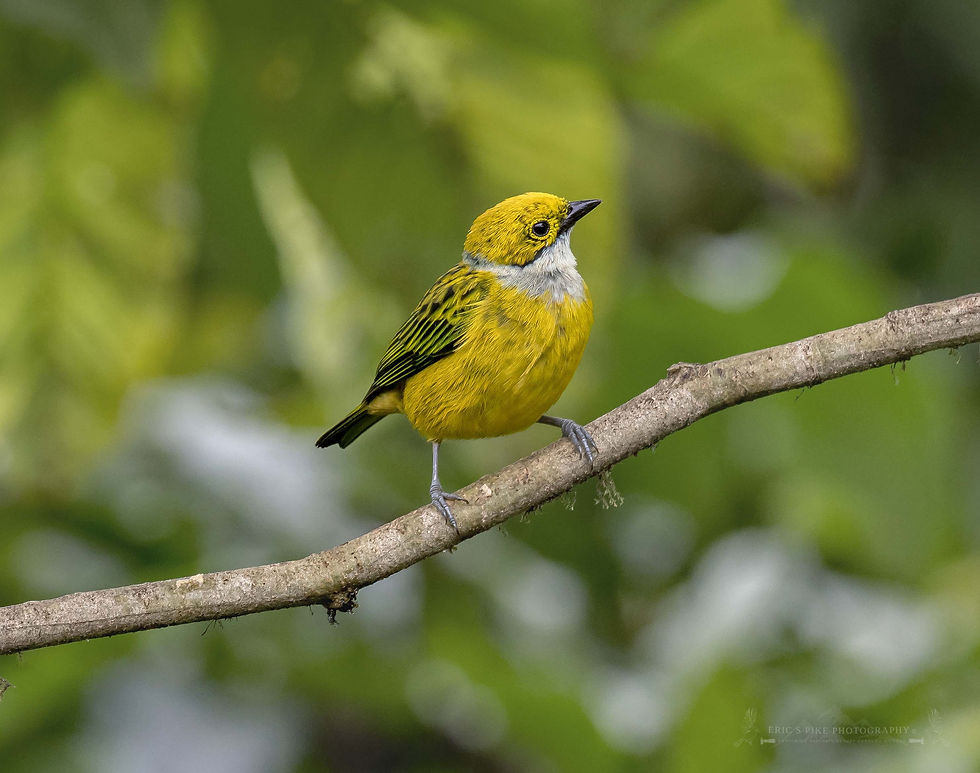
After stopping at town called San Miguel de Los Bancos for a delicious lunch at the Mirador Rio Blanco (that also has bird feeders on-site!), we then headed to our afternoon destination, a place called Sedro Fruittitour. I had no idea what I expected to see here, and was again both suprised and amazed at the variety of different birds found here! The Hummingbird feeders gave me three new trip species, Violet-chested, Purple-crowned Fairy, and Black-Throated Mango. The surrounding trees and grounds seemed to be filled with birds, as was the main feeding station! We checked off several new birds, with my biggest highlights being three birds I missed getting in Panama earlier this year; an Orange-Billed Sparrow, Bay-headed tanager, and Silver-Throated Tanager! I also got great photo ops of another bird I have never heard of, this time a Red-Billed Scythebill, a woodcreeper with an unusually curved long bill! Another notable lucky find was discovered near the entrance to the property, thanks to Danny's keen eye, a Peruvian Pygmy Owl, which I was lucky enough to score some record photos. This was indeed a full day, and after a late supper sleep came early, with thoughts on what Day 6 will bring!


Day 6
Another early rise, but this time we had an early 5 am breakfast before leaving for next adventure, exploring the area around Mindo, our guide's hometown! Not only did we have breakfast, but we also had a take-away lunch prepared for us this trip! This new are held potential for yet more new species, but the bright gray skies did not give me much hope for any decent photo ops.
The morning got off to a good start, as I managed to to get a few photos of a bird we seen a couple days prior, a White-Capped Dipper. Then a preening Torrent Tyrannulet let me get very close for some great photo ops, follwed up with my best yet photos of Saffron Finch and Tropical Parula! Further in the road we discovered and nesting pair of Southern Lapwings, a Southern House Wren, and a Black Phoebe.


From there things got less productive, as the birds seem to be intent on hiding and constantly moving. I to get a few record shots of an Azara's Spinetail, and a Three-Stripe Warbler. Luckily I had my macro lens with me, as there were plenty of flowers, bugs, and butterflies to keep me entertained! Ricky also got some great photos of a Bi-Colored Hawk!
After lunch we headed back to Mindo, scoring a few new birds such as Scarlet-Backed Woodpecker and Blue-Necked Tanager. The afternoon was spent in the town of Mindo, touring a Butterly Farm and then the town center, where we seen another new bird, an Pacific Hornero. Then we experienced a very informative (and delicious) chocolate tour before heading back to the lodge for supper and some sleep. It took some time for me to settle in as I was thinking ahead to Day 7, and the adventure we had in store!
Day 7
Another early breakfast at 5:00 am and on the road by 5:30, heading to our next birding destination, and the hopes of checking off the last of the top ten birds on my list! Today we are going higher, much higher, to the renowned Reserva Zuro Loma, located in the Andes Mountains 10,000 feet above sea level! This area would again have many new birds for us to see, that live in these higher elevations. The drive itself is breathtaking;, traveling across the mountains with outstanding views of the valleys and villages far below.

We arrived at the reserve, and discovered we were the only ones there, so the 4 of us had the entire area for ourselves! Due to the thin air breathing became more of a challenge, so we slowly descended down a few switchback trails to the viewing platforms, which were already starting to buzz with activity. The hummingbird feeders were busy with many species that we had not seen, as they prefer high elevations! I did not see my target bird, and was also informed that another bird on my list, the extremely rare Black-Breasted Puffleg, had not been recently seen either. But I did get some other new Hummingbird species such as Tyrian Metaltail, Buff-Winged Starfrontlet, and Gorgeted Sunangel! Several other species of birds began to arrive at the feeding stations, including several Masked Flowerpiercers, White-sided Flowerpiercer, Glossy Flowerpiercer, Blue-Capped Tanager, Great Thrush, and the beautiful Hooded Mountain Tanager.


The local guides at the reserve then led us down a trail to a enclosed wooded area. I had no idea what we were about to see but once we arrive they began to attempt to call out some birds! First bird to arrive was a White-Browed Brushfinch, which was soon followed by a Chestnut-Capped Antpitta! I had no idea that Antpittas were found here, so this was indeed a surprise, the first of many I was about to find out!
Back at the feeding station more birds began to arrive, such as White-Banded Tyrannulet, Supercilliaried Hemispingus, Yellow-Breasted Brushfinch, and Black-Crested Warbler. There was a bird bath fed by a stream that the birds were frequenting, so I kept my camera focused around that area, allowing for some nice action shots! Another bird then showed that I had yet to see..........a Spectacled Redstart!! This one was on my target list and I was able to get some photos I was very happy with.


The guides then led us to another area where again they began again to lure out yet more birds........where I was surprised yet again. A rare Chestnut-Naped Antpitta appeared, a bird I did not know existed, followed by yet another Antpitta I have never heard of, an Equatorial Antpitta!!! This place was indeed full of surprises, and there was still more to come.


Back at the feeders, Danny's keen eye spotted and Andean Guan hiding in the trees, followed up by the amazingly colorful Scarlet-Bellied Mountain Tanager. An unexpected Andean Tapeti, a small rabbit, was also seen, another surprise on this amazing trip.
If you are wondering if the bird I needed to complete my top 10 target bird list was seen, the answer is yes!! As in previous days, our luck continued to hold and we were graced by just a single one, but that one gave me great views and photo ops! The Sword-Billed Hummingbird has the longest bill of any hummingbird in the world, and it is found in Zuro Loma. And our group was lucky enough to have several visits from a single male! This bird was the reason i was so excited to head to this place, and words cannot describe how I felt to finally see and photograph it.

We had lunch at the reserve, then headed back the way we came, adding a few more birds along the way such as Turquoise jay, Slaty-Backed Chat, Dull-Colored Grassquit, Metallic-Green Tanager, Barred Becard, and Scarlet-Backed Woodpecker. A camera incident unfortunately put my long lens out of commission for the rest of the trip, limiting my range so photos became more of a challenge, so I mostly concentrated on getting record shots only. I got back to the lodge after supper tired but elated about today's adventure, and looking foward towards tomorrows trip, to see yet another unusual and unique bird!
Day 8
Another early rise, some great coffee at the restaurant, then off we go with our packed breakfast for our Day 8 adventure. Today's adventure is to head to a private location to see and hopefully photograph the only noctural fruit-eating bird in the world, the Oilbird! This bird is only found in limited locations in Northern South America, and Trinidad & Tobago. The reside in caves and crevasses, and roost all day, and only feed at night.
We first picked up the property owner, and I was able to get some photos of another new bird while there, this time a Masked Water-Tyrant. We then headed to the area where the owner then unlocked a metal gate, allowing us access to the only path into the crevasse. After walking up a short, winding path, we arrived at the viewing area and I could not believe my eyes.........all around and above me, were large brown birds with large glossy black eyes, all looking down at us from roosts dug into the sides of the cliff wall from these amazing birds. The sounds they made and the sights of them expertly navigating the narrow cave as they flew was unreal. I realized now that taking photos would be a challenge, but as this was not an enclosed cave but a open-top crevasse and the sun was just in the right location getting pics would certainly be possible. Setting up my tripod, using a shutter timer, combined with completely still roosting birds, very low shutter speed, and a usable ISO allowed me to take several photos I was very happy with.


We returned to the owner's residence, had lunch there, then headed back the road we came, birding along the way and adding a few more species to our lists, including another target bird for me, a Striped Cuckoo! As my long lens was still out of commission and would be for the rest of the trip, I managed to get record shots only. Back to the restaurant for another amazing supper, then off to bed to get ready for another early rise for Day 9!
Day 9
Early rise, quick stop for coffee and packed breakfast, and off we go for our next destination. Today we are headed to the lowlands and the well-known Rio Silanche Reserve. This 70 acre reserve has a 4-level viewing tower, as well as many trails to explore! We headed to the tower first and soon discovered that the birds were indeed plentiful, but also elusive for photos. New birds seen included Guayaquil Woodpecker, Velvety Manakin, Scarlet-Breasted Dacnis, Rufous-Winged Tanager, and Choco Tyranullet. The road back from the reserve also held a few new surprises, most notably a Red-Rumped Woodpecker!


We had lunch at a restaurant in the town of Pedro Vicente Maldonado, which was plentiful and delicious, then headed to our afternoon destination, the Milpe Bird Sanctuary. Unfortunately we arrived late in the afternoon with limited light and most of the bird activity was done for the day. I did take some hummingbird photos, and as we left the song of a Bright-Rumped Attila could be heard, but it was time to head to the lodge, get food, and prepare for our final day and return home.
Day 10
The plan for Day 10 was to do some morning birding at the lodge, hopefully see the Moustached Antpitta, have breakfast, then head out about 10:30am. There were some other birders at the lodge viewing are when we arrived, and we were again amazed at all of the birds that seemed to be everywhere! I got some great photos of a Squirrel Cuckoo, and a Slate-Throated Whitestart, as well as others!


Our flight didn't not leave until late at night, so we did make a couple stops along the way. We stopped at the Equator Museum (Very Cool!), where I did mange to add still more birds to my list, and then headed to the Zoo, where I also added a couple more wild birds while photographing the animals and birds there, including a beautiful Golden Grosbeak!


Danny dropped us off at the airport for our flights home, we said our goodbyes, and I told him that he was a wonderful guide, with amazing skills, lots of patience, and just a great person overall. While in the airport waiting for my flight, and I could not believe how fast the time went. 10 days; almost 300 species of birds seen, over 20,000 photos taken with my trusty Olympus OM-1. This was a simply unforgettable experience, from the Paz Family from making my stay feel like a home away from home, to Danny from getting us from place to place in one piece and then making sure we seen everything there was to see, to my trip companions Ricky and Lani, for sharing so many experiences, laughs, food, and wildlife...........I thank you all, for sharing and making this experience something I will always remember!


Comments